

What the Plinko casino game at 77JL costs per drop, board by board

The Plinko casino game at 77JL drops a coloured ball through rows of pegs into a numbered pocket, and the multiplier printed on that pocket sets your payout. The landing spot is chance with a spread you can calculate. What a drop costs sits in the paytable, the pocket multipliers: if every peg splits the ball evenly, all nine boards return 97 percent over the long run.
Where one ball lands before any colour is chosen
Plinko, a casino game built on pegs and pockets, sends each ball past a peg on every row, and each peg bounces it left or right. A pin setting counts those rows, so the 16-pin board has 16 rows.
A ball on that board has 65,536 possible left-right sequences. On an even split at every peg, the middle pocket collects 12,870 of them, about one drop in five.
Each end pocket collects exactly one sequence, a chance of 1 in 65,536, so the outer pockets look generous on the board and almost never pay. The pegs create this bell-shaped spread, and the colour you pick decides which row of multipliers pays, as the later sections show.
Every Plinko odds figure on this page assumes that even split at every peg, the standard model for a pegboard drop, known as a Galton board.
All nine boards return 97 percent once every pocket is added up
You multiply each pocket’s multiplier by its landing chance, add the results, and every board in the Plinko casino game at 77JL comes to 97.00 percent, its theoretical return to player (RTP). Three colours times three pin settings makes nine paytables, and each returns 97 chips for every 100 staked over a long run.
Take the 12-pin green board. Its middle pocket carries a 0.5 multiplier and collects 22.56 percent of drops, which adds 11.28 to the total. The two pockets marked 1 beside it collect 19.34 percent each and add 38.67 more, and the ten outer pockets supply the remaining 47.05.
This is where the house edge sits in Plinko, the casino game at 77JL. The route of the ball is chance with a fixed spread, so the missing 3 chips come from multiplying the paytable by that spread, and no drop and no streak of drops changes them.
These figures are calculated from the paytable on the board, not quoted from a published return rate.
How often does each colour pay under the chip?
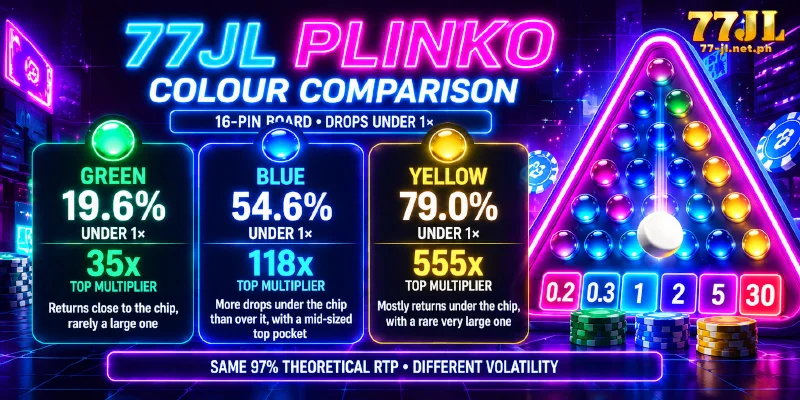
On the 16-pin board a drop pays under the chip 19.6 percent of the time on green, 54.6 percent on blue and 79.0 percent on yellow. Yellow’s figure is highest because its centre pockets, where the ball lands most often, all pay less than 1x.
Your colour pick at 77JL chooses which of three rows of Plinko multipliers pays, while the pegs and pockets stay the same. The table compares the rows on the 16-pin board by their top pocket and by how often a drop pays under the chip.
| Colour | Top multiplier | Drops under 1x | What you see more often |
|---|---|---|---|
| Green | 35x | 19.6% | Returns close to the chip, rarely a large one |
| Blue | 118x | 54.6% | More drops under the chip than over it, with a mid-sized top pocket |
| Yellow | 555x | 79.0% | Mostly returns under the chip, with a rare very large one |
RANDOM, a fourth button on the casino game Plinko, sits beside the three colours. A pocket marked 1 returns the chip itself, so the table above does not count it as under 1x.
Take a 100 chip on the 16-pin board. On green, about one drop in five returns less than 100 and the top pocket returns 3,500. On yellow, about four drops in five return less than 100, and the top pocket returns 55,500 but sits at the two ends, where the ball rarely goes.
That gap is volatility, how rough a session feels, and the colour sets it while the price stays at 3 percent.
What 12, 14 and 16 pins change on the board
Plinko multipliers at 77JL grow with the PINS setting while the return stays at 97 percent. Each step from 12 to 14 to 16 pins adds two pockets, thins out the end pockets and lifts the top multipliers, as the table shows for all three colours.
| Pins and pockets | Middle pocket chance | Top multiplier (green, blue, yellow) | What changes |
|---|---|---|---|
| 12 pins, 13 pockets | 22.56% | 11x, 25x, 141x | Narrowest spread, smallest top pockets |
| 14 pins, 15 pockets | 20.95% | 18x, 55x, 353x | Between the two on both counts |
| 16 pins, 17 pockets | 19.64% | 35x, 118x, 555x | Widest spread, largest top pockets |
Either end pocket pays the top multiplier, so on the yellow board it lands once in 2,048 drops at 12 pins, once in 8,192 at 14 and once in 32,768 at 16, while the multiplier itself rises from 141x to 353x to 555x.
So Plinko, the casino game at 77JL, spreads one 3 percent edge across three pin settings.

What auto and the four chip tiers commit you to
Plinko is a casino game with four chip tiers, FRIENDLY, CASUAL, EXPERT and HIGH ROLLER, and an AUTO mode with three settings: 10 rounds, 20 rounds, or an infinity setting with no round count. The tiers run in order of chip size, and neighbouring tiers share chip values such as 50, 100 and 200.
- FRIENDLY: chips of 15, 20, 30, 40, 50 and 60
- CASUAL: chips from 50 to 100 in steps of 10
- EXPERT: chips from 100 to 200 in steps of 20
- HIGH ROLLER: chips from 200 to 300 in steps of 20
Suppose you stake one 100 chip on one colour per round. Ten auto rounds then put 1,000 chips in play and twenty put 2,000, while the infinity setting has no round count to cap the total.
Because the total committed is the chip size multiplied by the rounds, set the round count first: ten rounds at the 15 chip puts 150 chips in play, while twenty rounds at the 300 chip puts 6,000, and the 3 percent edge applies to every one of those chips.
The Plinko casino game in the Cards section at 77JL
The Plinko casino game is one of 18 titles in the Cards category at 77JL, and its tile carries the KINGMAKER badge. Rebate is a percentage of your valid bet, the stake that counts toward each tier, credited back win or lose in all six game sections.
Plinko stakes therefore earn the Cards rebate, which starts at 0.5 percent and rises to 1.5 percent as your cumulative valid bet grows.
Bonuses follow their own game lists, and Cards is on none of three: the Register Bonus names Slot and Fish, while the First Deposit and Daily Deposit bonuses name Slot only. With one of those bonuses active, a Plinko stake falls outside the list the bonus names.
If Plinko is the game you plan to play, the cashier’s Do Not Participate In Any Promotions option attaches no wagering requirement, the amount you must bet before a bonus can be withdrawn, to your deposit.
You must be 18 or over to play any game at 77JL, and the responsible gaming page covers self-exclusion and deposit limits.
FAQ
These three answers come from the rules screen and the paytable of Plinko, the casino game at 77JL.
What happens if the game malfunctions?
Plinko’s rules screen states that a malfunction voids all wins and plays.
What do the pockets marked 0 and 0.2 pay?
Pockets marked 0 pay nothing and pockets marked 0.2 pay a fifth of the chip, so a 50 chip landing on a 0.2 pocket pays 10. Both sit in the centre of the yellow boards, which is also where the ball lands most often.
Are the winning amounts on the rules screen real?
No, the example win banners are samples. The rules screen says all values and screenshots except the paytable are for illustration, so the three multiplier rows above the colour buttons are the reference.
Read the paytable, not the path
The path is chance and the price is the paytable: a drop in the Plinko casino game follows a spread the pegs fix, and 77JL’s charge sits in the multipliers, 3 percent on all nine boards. Colour, pins, chip tier and round count shape the swing and the stake in play, never the price of a chip.